
Inside SUPATRAC HQ: A Rare Look at How These Tonearms Are Built

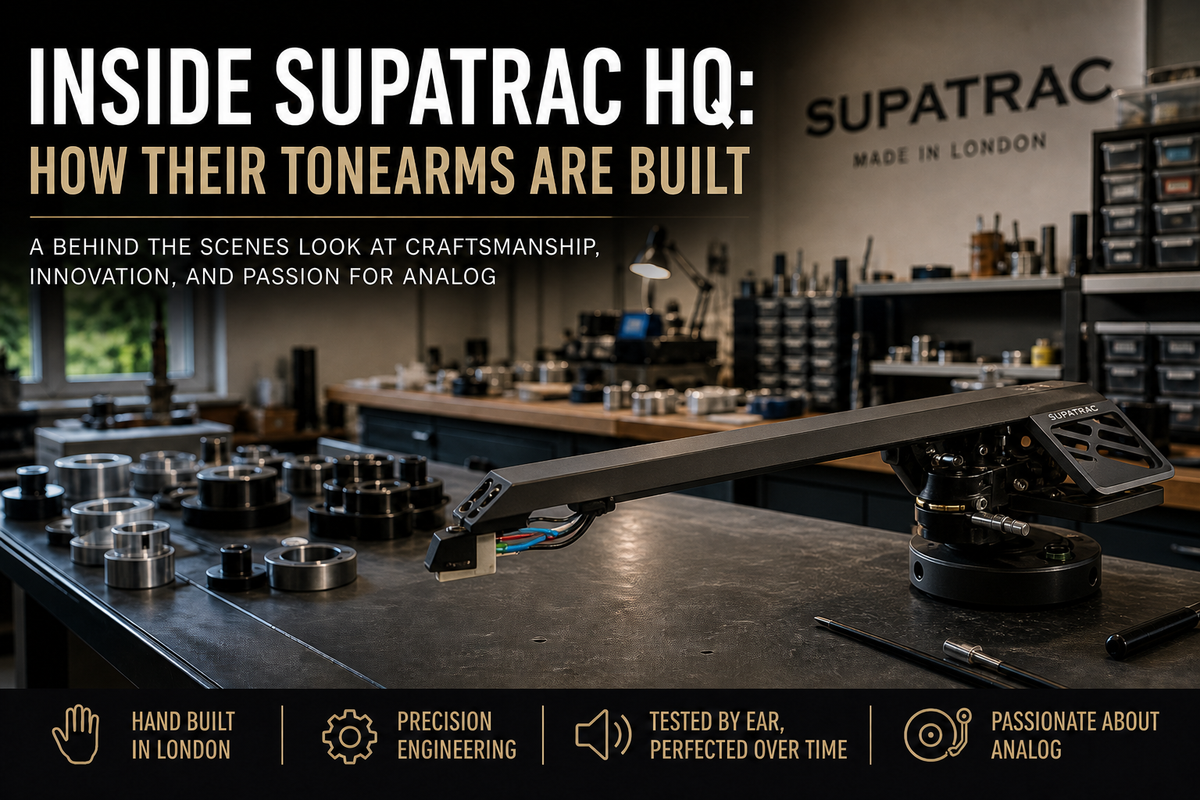
During a recent trip to London, I had the opportunity to visit SUPATRAC HQ and spend time with Richard Braine to see firsthand how the Blackbird and Nighthawk tonearms come to life. What I expected was a small boutique operation. What I didn’t expect was just how much of the process is still rooted in hands-on craftsmanship.
This isn’t a large-scale manufacturing facility. It’s something much more personal.
From the moment you step inside, it becomes clear that SUPATRAC is still operating at its core exactly where it all began. The same house where Richard first started experimenting with tonearm design is now the heart of a growing operation. That alone says a lot. As demand increases, many companies move toward scaling through outsourcing or automation. SUPATRAC has chosen a different path, expanding within its original space while maintaining complete control over the build process.
And that decision shows in the final product.
Built by Hand, Not by Compromise
One of the most striking things during the visit was just how much of each tonearm is hand-built. From machining and shaping components to assembly and finishing, there’s a level of care here that’s difficult to replicate in a larger, more automated environment.
You see it in the details. You feel it in the way each part is handled. This isn’t about pushing units out the door. It’s about getting it right.
The workshop itself reflects that philosophy. It may look busy, even chaotic at first glance, but there’s a system behind it. Every tool, every component, every stage of the process has a purpose. It’s a well-oiled machine, just not in the traditional sense.
Craftsmanship That Stands Out
We talk a lot in this hobby about diminishing returns, about where upgrades stop making sense. But when you see the level of craftsmanship that goes into something like a SUPATRAC tonearm, you start to understand where the value comes from.
This isn’t mass production. It’s precision built over time, refined through iteration, and tested constantly in real listening environments.
And that last part matters.
The listening room at HQ isn’t just for show. It’s where designs are validated, where prototypes are pushed, and where decisions are made based on actual listening, not just measurements. That balance between engineering and ear is something you don’t always see, and it’s clearly part of what defines SUPATRAC’s approach.
A Glimpse Into What’s Next
While visiting, I also had the chance to see several prototypes in various stages of development. Some early concepts, some more refined. There’s clearly ongoing experimentation happening behind the scenes.
I even had the opportunity to hear one of those prototypes in action.
That’s about as much as I can share for now.
But what I will say is that it’s always interesting to see where a company is heading, especially one that’s this committed to doing things their own way.
Final Thoughts
Walking through SUPATRAC HQ reinforces something that’s easy to forget in today’s market. Not everything is built for scale. Some products are built for passion, for performance, and for the people who genuinely care about the experience.
SUPATRAC feels like one of those companies.
They’ve managed to grow without losing sight of what made them special in the first place. Still hand-built. Still operating from the same foundation. Still focused on delivering something that stands apart.
And after seeing it all up close, it’s hard not to respect that.
Richard Braine, the genius behind SUPATRAC, takes us through a factory tour at the SUPATRAC HQ in London, UK.