When Did Vinyl Become a Luxury Hobby?
Vinyl records were once an affordable way to discover music. Today, premium pressings, luxury packaging, and rising prices are transforming the hobby into something far more exclusive. Has vinyl become a luxury market?

There was a time when vinyl records were the affordable way to discover music.
You would walk into a record store with twenty dollars and leave with a stack of albums. Some new. Some used. Some completely unknown. The barrier to entry wasn’t particularly high, and that was part of the magic. Vinyl collecting felt personal, accessible, and deeply connected to the music itself.
Today, that same twenty dollars might barely cover a single new LP.
And somehow, along the way, vinyl stopped feeling like a hobby for everyone and started feeling like a luxury market.
The Price Explosion Nobody Saw Coming
Over the last several years, record prices have climbed at a pace that would have seemed absurd a decade ago.
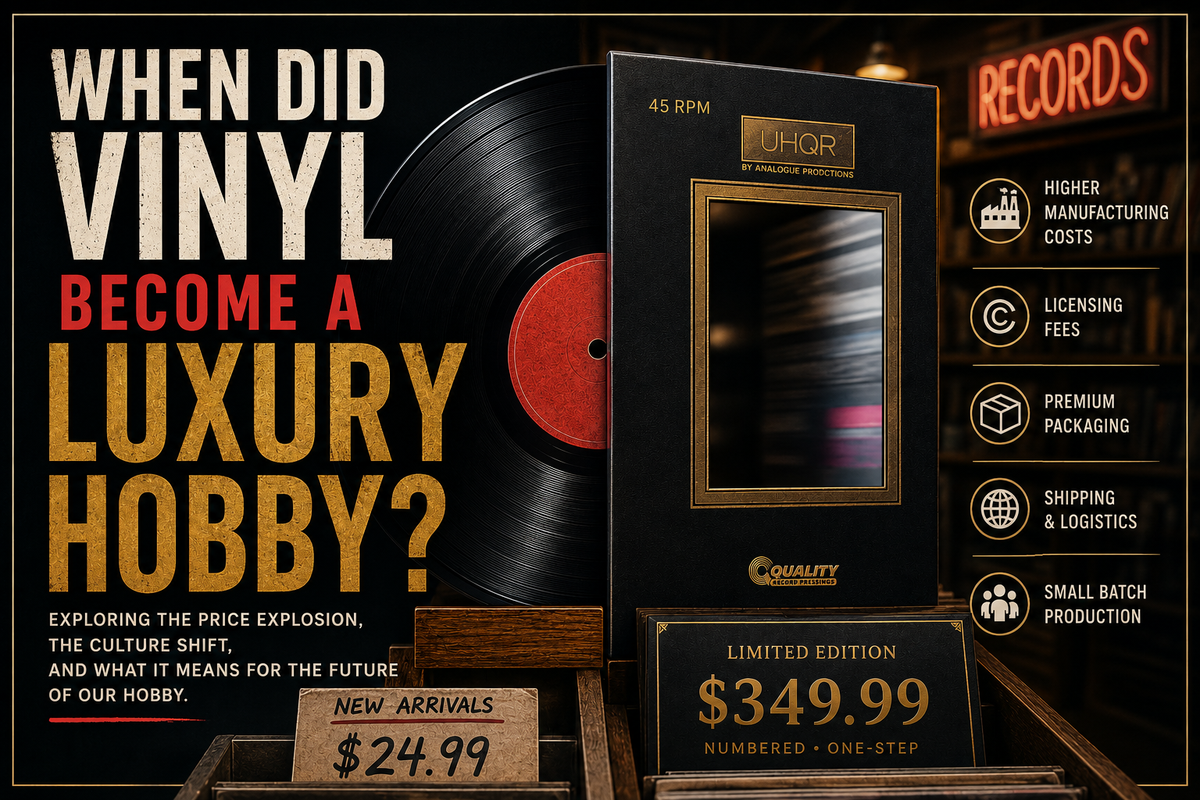
Standard new releases regularly land between $35 and $50. Audiophile pressings from companies like Mobile Fidelity Sound Lab, Analogue Productions, and others now routinely push past $100. Limited editions can hit $150 to $200 without much resistance from collectors. And recently, we’ve even seen specialty releases approach the $600 mark.
That raises a serious question:
When did listening to music become something that required luxury-level spending?
To be fair, there are legitimate reasons behind some of these prices. Manufacturing costs have increased. Licensing costs have increased. Packaging has become more elaborate. Pressing plants remain backed up. Shipping costs continue to rise. Small batch production is expensive.
I understand all of that.
But there is also no denying that the vinyl market itself has changed.
Vinyl Has Become a Status Symbol
Scroll through social media long enough and you’ll notice something interesting.
The conversation is often less about the music and more about the object.
Limited to 3,000 copies.
Ultra-premium box set.
One-step process.
Hand-numbered.
45 RPM.
Super vinyl.
UHQR.
MoFi.
First stamper.
Original pressing.
The language surrounding records increasingly resembles the luxury watch market or sneaker culture more than the simple act of discovering music.
And honestly, I think that shift has changed the psychology of collecting.
For many people, records are no longer just albums. They’re trophies. Investments. Flex pieces for Instagram shelves and YouTube thumbnails.
There’s nothing inherently wrong with collecting beautiful things. I own premium pressings myself, and some of them genuinely deliver incredible listening experiences. But somewhere along the way, parts of the hobby started prioritizing exclusivity over accessibility.
That worries me.
Younger Collectors Are Being Priced Out
One of the best things about the recent vinyl resurgence has been seeing younger generations embrace physical media.
Teenagers and twenty-somethings are buying turntables, exploring full albums, and learning to sit down and actively listen to music again. That’s genuinely exciting.
But what happens when entry-level participation becomes financially unrealistic?
A decent starter setup can easily exceed $1,000 once you factor in a turntable, speakers, accessories, and a small collection of records. Then add modern vinyl pricing on top of that.
If every major release costs $40 to $60, how sustainable is that for younger collectors?
At some point, the industry risks creating a hobby that only appeals to people with significant disposable income.
And if that happens, vinyl could slowly lose the cultural diversity and accessibility that helped fuel its comeback in the first place.
The Audiophile Market Isn’t Entirely the Problem
Here’s where I think nuance matters.
I do not believe premium audiophile releases are inherently bad for the hobby.
In fact, many of them are extraordinary.
Some of the best sounding records I’ve ever heard came from premium reissue labels that invested heavily in mastering, plating, pressing quality, and packaging. Those releases preserve music history in a way streaming simply cannot replicate.
The real issue is when premium pricing starts becoming normalized across the entire industry.
Not every release needs to be a deluxe collector’s item.
Sometimes people just want an affordable, well-pressed copy of an album they love.
And frankly, the industry could benefit from remembering that.
We May Be Reaching a Tipping Point
There’s a growing divide forming inside the vinyl community.
On one side, you have collectors chasing ultra-premium editions, boutique pressings, and exclusivity. On the other, you have music fans simply trying to participate without spending hundreds of dollars every month.
Both groups matter.
But if the market continues drifting exclusively toward luxury positioning, the long-term health of the hobby becomes questionable.
Vinyl became popular again because it felt tangible, emotional, and human in a digital world. It gave people a deeper connection to music.
That emotional connection is still here.
The question is whether the hobby can remain accessible enough for future generations to experience it too.
Because at the end of the day, records were never supposed to be just luxury objects sitting on shelves.
They were meant to be played.