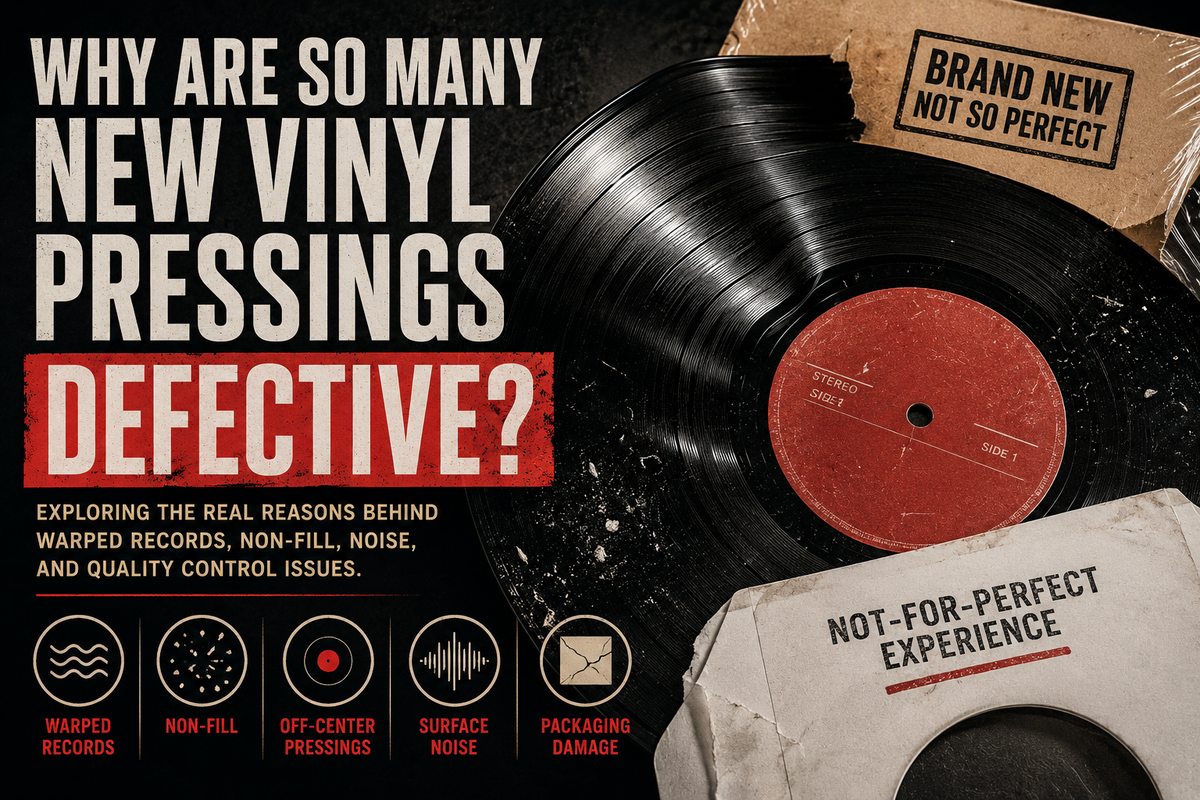
Why Are So Many New Vinyl Pressings Defective?
Vinyl records are more popular than ever, but many collectors are asking the same question: why are so many new pressings defective? From warped records and non-fill to surface noise and off-center pressings, modern vinyl quality control has become a growing frustration in the hobby.

For a format that has become increasingly expensive, modern vinyl can be surprisingly inconsistent.
Collectors today routinely spend $35, $50, or even well over $100 for new records, only to discover warps, non-fill, off-center pressings, surface noise, scratches, seam splits, or packaging damage the moment the shrink wrap comes off.
And if you spend enough time in vinyl communities online, you quickly realize something:
This isn’t an isolated issue.
It’s become one of the most frustrating realities of modern record collecting.
So what exactly happened? Why are so many new vinyl pressings defective, especially during what should be vinyl’s golden era?
The answer is more complicated than most people realize.
The Vinyl Boom Changed Everything
A little over a decade ago, vinyl was still considered a niche format.
Today, it’s mainstream again.
Major artists release albums on vinyl by default. Retail chains dedicate entire sections to records. Pressing plants are overloaded. Demand continues to grow year after year.
On paper, that sounds like a dream scenario for vinyl lovers.
But the rapid growth created enormous pressure on the manufacturing side of the industry.
Many pressing plants simply weren’t prepared for the scale of the resurgence.
Some factories expanded too quickly. Others pushed aging equipment far beyond its intended capacity. Skilled technicians became harder to find. Turnaround expectations shortened. Production schedules tightened.
And unfortunately, quality control often became the casualty.
Pressing Plants Are Running at Maximum Capacity
Most vinyl collectors imagine records being manufactured slowly and carefully in small artisanal facilities.
The reality is often far less romantic.
Many pressing plants today are operating around the clock trying to keep up with overwhelming demand. When machines run continuously under heavy workloads, defects become more likely.
Small mistakes during pressing can create major problems:
- improper cooling
- rushed cycle times
- worn stampers
- temperature inconsistencies
- contamination in the vinyl pellets
- poor handling during packaging
All of these issues can affect the final record sitting on your turntable.
And because production demand remains so high, there is often less time available for thorough inspection.
Some Defects Are Becoming Shockingly Common
Collectors today have become painfully familiar with certain problems.
Warped Records
Perhaps the most common complaint in modern vinyl.
Some warps are minor and harmless. Others can severely affect playback or cartridge tracking. Heat exposure during shipping certainly contributes, but poor cooling during manufacturing can also play a role.
Ironically, even expensive audiophile releases are not immune.
Non-Fill
This is the defect many collectors dread most.
Non-fill occurs when the vinyl fails to properly flow into the grooves during pressing. The result is a tearing or zipper-like sound during playback.
Once you hear it, you can’t unhear it.
And unfortunately, no amount of cleaning will fix it.
Off-Center Pressings
This issue remains surprisingly common.
An off-center spindle hole causes audible pitch instability, especially during sustained piano notes, vocals, or acoustic passages.
For listeners sensitive to pitch variation, it can completely ruin an otherwise excellent pressing.
Surface Noise and Contamination
New records are supposed to feel premium.
Yet many arrive with fingerprints, debris, paper dust, scuffs, or embedded noise straight from the factory.
Some of this can be improved with proper cleaning. Some cannot.
Either way, it creates frustration when consumers are paying premium prices for supposedly high-end products.
Vinyl Has Become a Faster Business
There’s another uncomfortable reality the industry doesn’t always discuss openly:
Vinyl is no longer just about music lovers.
It’s also about volume.
Major labels now view vinyl as an extremely profitable revenue stream. Limited variants, collector editions, retailer exclusives, and deluxe packaging all drive higher margins.
The result?
The focus sometimes shifts from making the best possible record to simply getting product onto shelves quickly enough to meet demand.
And when speed becomes the priority, quality can suffer.
Audiophile Labels Often Set a Higher Standard
To be fair, not all vinyl production is equal.
Many audiophile-focused labels still place enormous emphasis on quality control, mastering, plating, and pressing consistency. Companies like Analogue Productions, Impex Records, and certain releases from Mobile Fidelity Sound Lab often demonstrate noticeably higher production standards than mass-market releases.
That does not mean defects never happen. They absolutely do.
But there is often greater attention paid to the manufacturing process itself.
Unfortunately, that level of care usually comes with significantly higher pricing.
Social Media Has Also Changed Expectations
There’s another factor worth mentioning.
Collectors today are far more informed and connected than ever before.
Twenty years ago, someone might have purchased a noisy record and assumed it was normal. Today, buyers immediately compare experiences online, share videos of defects, and discuss pressing quality across forums, YouTube, Reddit, Facebook groups, and Discogs reviews.
In some ways, defects may not necessarily be happening dramatically more often.
We’re simply seeing and documenting them more openly.
Still, judging by the sheer volume of complaints across the hobby, it’s difficult to deny that quality control remains a significant issue.
So… Is Vinyl Still Worth It?
Honestly?
For me, yes.
Because when vinyl is done well, there is still nothing quite like it.
A great pressing played on a properly set up system can feel immersive, emotional, physical, and deeply human in a way digital playback sometimes struggles to replicate.
But I also understand why newer collectors become frustrated.
When records continue getting more expensive while quality remains inconsistent, people begin questioning whether the value proposition still makes sense.
And that’s a conversation the industry probably needs to take more seriously.
Because vinyl’s resurgence was built on passion.
If collectors begin associating the format with disappointment instead of excitement, that momentum becomes much harder to sustain long term.